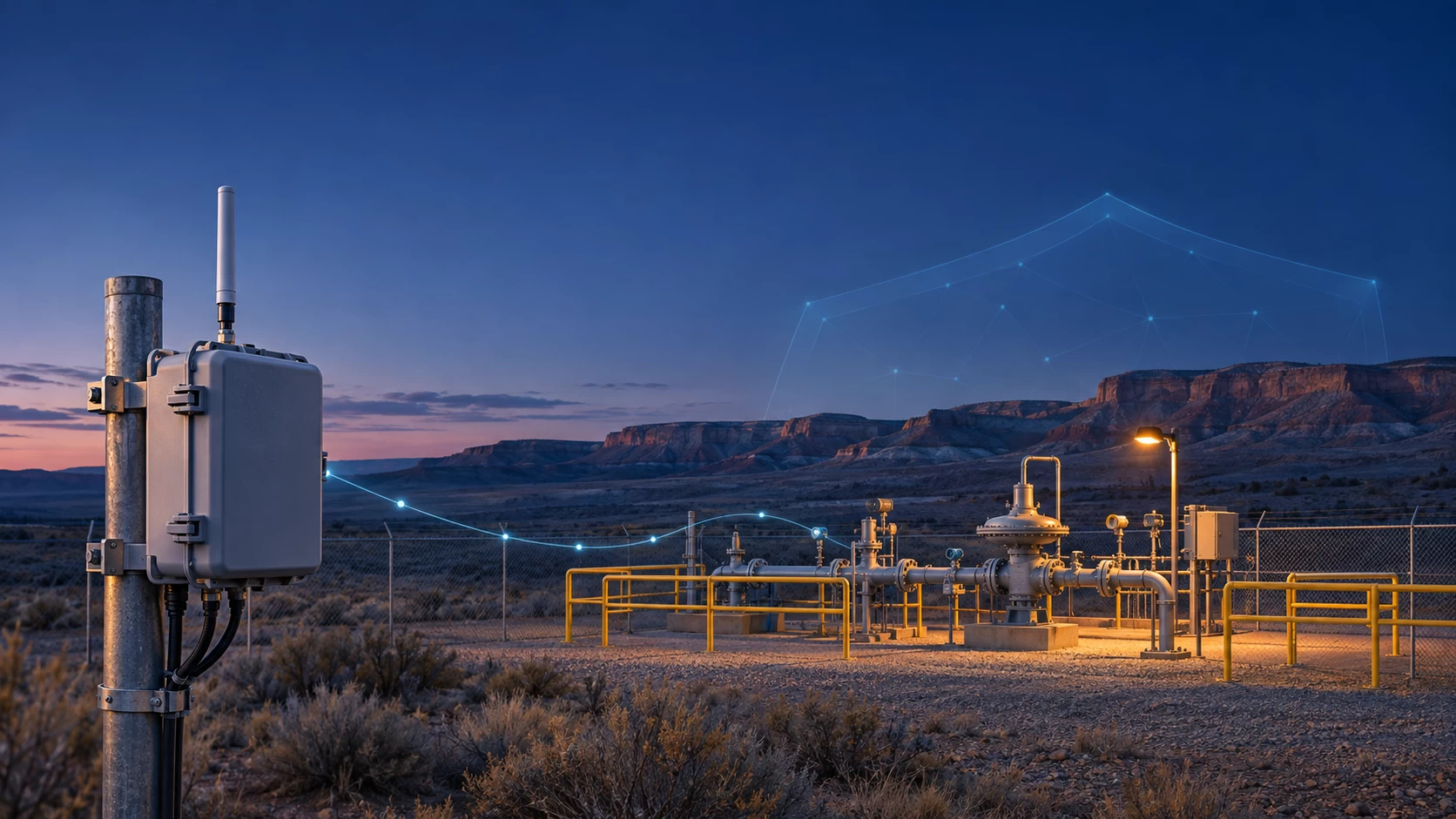
The field reading is only as trustworthy as the path behind it
A remote gas site may have a perfectly serviceable meter or pressure instrument, but the data operators see can still be incomplete, stale, or exposed to the wrong people. A pulse has to be collected correctly. A pressure reading has to retain its time and source. A cellular message has to reach the right server. And the people using the dashboard need appropriate access.
That makes a modern remote monitoring installation more than a sensor and an antenna. It is a small operational-technology (OT) system, even when the application is observation rather than control. A reliable design needs to consider data accuracy, communications availability, access control, and what happens when any part of the path fails.
Why this conversation matters now
On September 21, 2026, the National Institute of Standards and Technology (NIST) released the initial public draft of SP 800-82 Revision 4, Guide to Operational Technology (OT) Security. Among its proposed changes are broader treatment of industrial IoT and cloud-connected OT, expanded asset-management and network-monitoring guidance, and security architecture focused on system-management functions and zero-trust principles.
Two days later, on September 23, the FBI and CISA issued a fact sheet on third-party ICS integrators, emphasizing appropriate access, exposure reduction, and planning for dependencies on outside providers.
These publications address much broader OT environments than a typical standalone gas-monitoring endpoint. Their practical message nevertheless applies: operators should know what is connected, what it can access, and how they would recognize or recover from a failure.
NIST SP 800-82 Revision 4 is an initial public draft, not a final revision or a newly enacted legal requirement. NIST is accepting comments through November 30, 2026. Revision 3, finalized in September 2023, remains the current final edition. The NIST Cybersecurity Framework is guidance, not a universal mandate for every field site. An operator's actual obligations depend on the equipment, jurisdiction, contracts, and applicable rules.
1. Can you account for every connection from instrument to dashboard?
Begin with an accurate inventory. Identify the field instrument and approved signal source, telemetry device, firmware version, power supply, cellular service, data destination, and any SCADA or reporting integrations. Record who owns each component and who can maintain it.
This matters when an organization has hundreds of sites installed across several equipment generations. An obsolete modem, unknown SIM account, inherited password, or undocumented data feed can become an operational problem long before it becomes an obvious cybersecurity incident.
A monitoring inventory should also identify whether a link is read-only or has any command or configuration capability. Those are different risk profiles.
2. Who can see the data, and who can change the system?
A field technician may need site status and history. A company manager may need a wider view across locations. A system administrator may need device and account configuration. Those roles do not automatically require the same privileges.
Apply least-privilege access, review dormant accounts, and verify how credentials, multifactor authentication where supported, vendor access, and administrative changes are managed. If an outside integrator needs access, define the purpose, scope, duration, and method of oversight.
For monitoring-only systems, it is helpful to keep the boundary between reading operational data and changing industrial equipment explicit. A web dashboard should not be assumed to have authority over a meter, regulator, or shutdown function simply because it can display their readings.
3. What protects the message between the field and the server?
Cellular connectivity is a useful transport, but the presence of an LTE-M or other cellular modem does not, by itself, prove that an application has end-to-end encryption or strong message authentication. Those protections must be evaluated at the complete system level.
For new deployments, ask whether data is encrypted from the device to the intended application endpoint, how the device authenticates the server, how credentials and keys are provisioned or rotated, and whether messages can be duplicated or replayed without detection. The answers should be demonstrated for the particular hardware and firmware in service, not inferred from the modem's marketing specifications.
Security controls should be matched to the site's operational consequences. A system collecting trend data needs appropriate safeguards; a system performing a safety-critical control function requires a substantially different engineering and assurance process.
4. Is a zero reading truly zero, or is the site simply offline?
Consider a site whose authorized pulse output normally shows intermittent activity. If the latest upload displays no new pulses, the result may reflect a quiet interval. If the last upload was six hours ago, however, the dashboard cannot establish what happened during those six hours unless the field system demonstrably retained the relevant data.
Good monitoring distinguishes measurement time from upload time, reports the age of the last reading, and makes stale or missing communications visible. When counting cumulative pulses, the counting method, continuity across restarts, and reconciliation after an outage should be verified as part of commissioning. Do not assume every device stores a complete history while disconnected.
An offline warning is a communications or device-health signal. It is not proof of zero flow, a leak, or a safe process condition.
5. What happens if the network, power source, or vendor is unavailable?
Remote installations routinely depend on conditions outside the operator's control: cellular coverage, power availability, weather, and third-party services. A practical design documents expected reporting intervals, stale-data thresholds, local retention behavior if available, escalation contacts, and field verification procedures.
Test the recovery path. If a device misses several reports, who receives the notice? Can staff determine the last reliable value? Can a field technician still inspect the meter and operate the site using established procedures? Does the organization retain the configuration information it needs if a supplier is unavailable?
The right answer is not always a faster reporting interval. It is a reporting and response strategy suited to the site's risk, power budget, and operating conditions.
A small field example
Imagine two remote regulator locations, both showing a flat pulse trend this morning. At the first site, the device checked in on schedule and the reported count has not advanced. At the second, the last successful upload was yesterday, and the dashboard is showing its last known value.
Those two screens may look similar without clear data-age indicators, but they warrant different investigations. At the first site, a technician may review expected operations and the authorized meter output. At the second, communications and device health need to be checked before drawing any conclusion about activity. Neither condition independently establishes a leak or equipment failure.
That is where security, data integrity, and operational reliability meet: trustworthy monitoring is as much about knowing what the data cannot tell you as knowing what it can.
Where R3CON fits in the operating environment
DFELAB's R3CON platform provides a remote monitoring layer for supported field inputs, including authorized pulse signals and appropriately selected pressure and temperature sensors. Its portal helps teams review historical readings, reporting status, and site conditions without replacing the underlying measurement equipment.
R3CON is not a certified custody-transfer meter, leak-detection system, emergency shutdown device, or substitute for a safety instrumented system. Security features and local data-retention behavior must be verified against the specific deployed hardware, firmware, server configuration, and integration before an operator relies on them. The presence of a portal or cellular modem should never be represented as proof of NIST compliance.
The useful starting point is a scoped field evaluation: determine which signals are authorized and meaningful, confirm the data path and user roles, and agree on what constitutes a stale report or an actionable anomaly.
A practical 30-minute review for field teams
Before adding another remote monitoring location, ask five questions:
- Can we identify its instrument, telemetry unit, firmware, SIM/network, and receiving system?
- Do we know which users and outside providers can access its data and settings?
- Have we verified transport protection and device/server authentication rather than assumed them?
- Will the dashboard clearly distinguish live, stale, and last-known readings?
- Is there a documented response when communications fail or a reading looks abnormal?
Answering these questions will not create a complete OT security program. It will, however, make the next telemetry deployment easier to operate, audit, and maintain.
Primary references
NIST SP 800-82 Revision 4, initial public draft (published September 21, 2026; public comments due November 30, 2026).
NIST SP 800-82 Revision 3, current final guidance (September 2023).
CISA and FBI: Considerations for Critical Infrastructure Operators Working With Third-Party ICS Integrators (September 23, 2026).
NIST Cybersecurity Framework 2.0 (February 2024).
Start with a field site you already know
Discuss a focused R3CON field trial around an approved signal, a realistic reporting interval, and the visibility your team actually needs. We can review the monitoring approach without replacing your existing measurement or control equipment.
Request a Field Trial