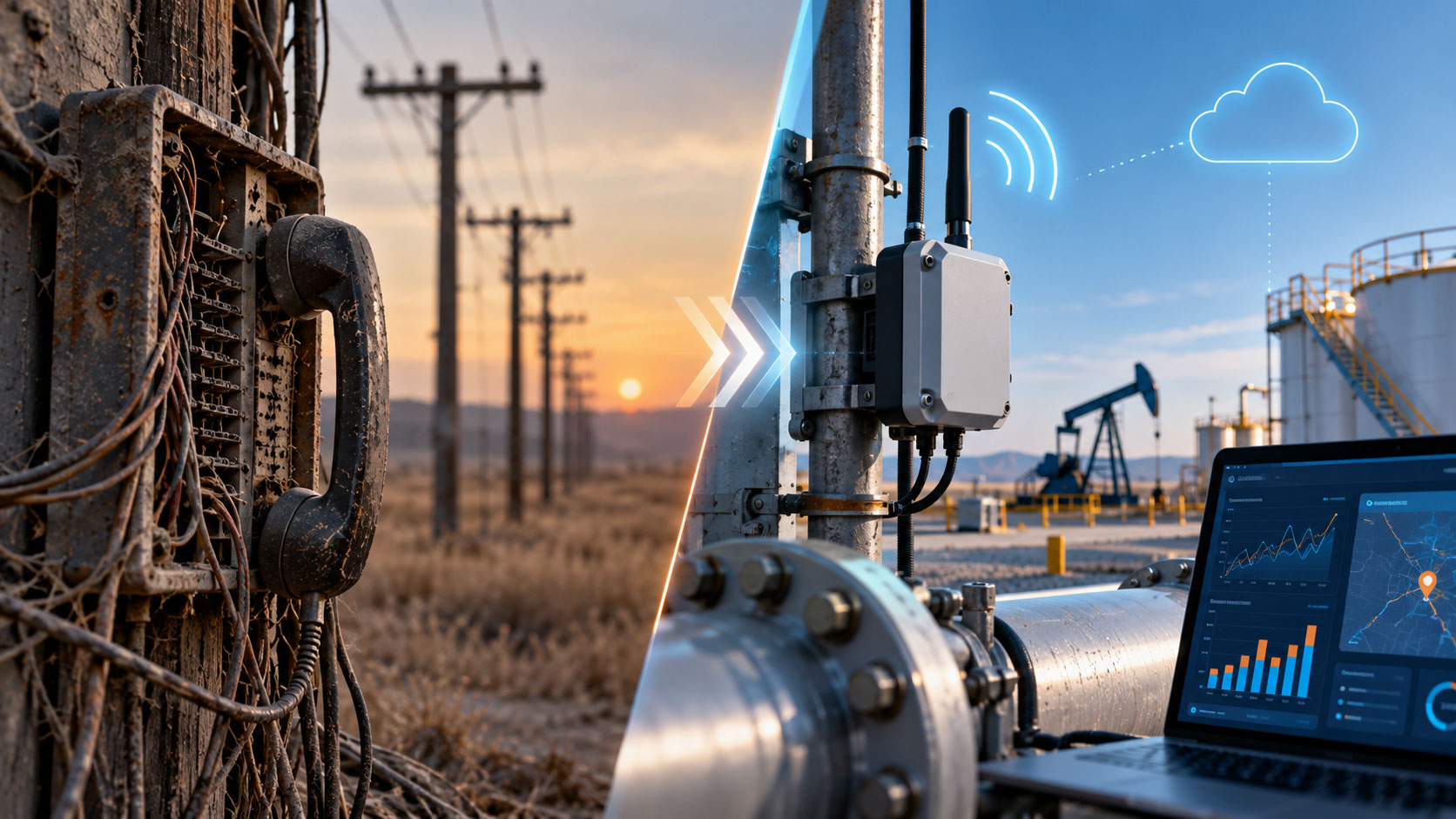
Why POTS lines are becoming a business risk
For decades, Plain Old Telephone Service (POTS) provided a familiar connection for industrial sites, security systems, alarms, and remote equipment. Copper-based telephone circuits often became part of the infrastructure that operators rarely needed to think about. That is changing. Telecommunications carriers are modernizing networks and moving investment toward fiber, IP, and wireless services. As legacy copper infrastructure is retired market by market, industrial operators need to identify what still depends on it.
This does not mean every POTS line in the United States has a common shutdown date. Availability, notices, replacement offerings, and timing vary by provider and location. Nevertheless, waiting for a cancellation notice can leave a remote site with little time to evaluate an appropriate replacement.
What changed in 2026?
In March 2026, the Federal Communications Commission announced rules intended to reduce barriers to copper-network retirement and speed modernization. Updated requirements appeared in the Federal Register in October 2026. These changes are an important signal about the direction of the communications industry, but they are not a declaration that all analog telephone lines have already disappeared or will terminate on one fixed date.
For businesses, the practical takeaway is straightforward: inventory legacy connections and develop migration plans before the underlying communications service becomes a point of failure.
Why industrial sites are especially exposed
A single telephone line can support far more than voice calls. Remote facilities may still use analog circuits for alarm dialers, automated readings, legacy telemetry, control equipment, and other machine-to-machine communications. Unlike a staffed office, a remote installation might not reveal a communications failure until data is missing or an exception goes undetected.
In oil and gas, water, utilities, and other distributed operations, the concern is often not simply losing a connection. It is losing visibility into what is happening at a field location between visits or periodic reports.
How cellular IoT changes the approach
Industrial Internet of Things (IoT) devices can capture signals at the asset and transmit selected measurements through supported cellular networks to a cloud platform. Depending on the equipment and deployment, a modern system can provide remote dashboards, historical trends, device-health information, and configurable alerts without maintaining a dedicated analog telephone circuit.
For example, an operator can monitor pulse counts from a compatible meter or observe changes in pressure and temperature. The value is not merely receiving the next scheduled reading. It is establishing enough visibility to recognize patterns that merit investigation, such as unexpected consumption increases, abnormal operating conditions, or a site that has stopped communicating.
A replacement is more than a cellular modem
Not every POTS-connected device can be swapped directly to a generic cellular adapter. A successful migration depends on the original equipment, signaling method, supported cellular coverage, power availability, data requirements, and the criticality of the application.
Safety-of-life systems, regulated alarms, emergency communications, and any equipment requiring specific line supervision or certification must be assessed against their own applicable requirements. A general-purpose IoT telemetry device is not automatically a drop-in replacement for a fire-alarm dialer, elevator telephone, or every legacy modem.
Where R3CON fits
DFELAB developed R3CON for remote field telemetry, including compatible pulse and sensor monitoring applications. By collecting measurements at the source and reporting them to a centralized portal over cellular connectivity, R3CON helps operators move from infrequent manual visibility toward consistent operational trends and exception awareness.
For a facility relying on a legacy phone line to communicate metering or operating information, the first step is to determine whether the current signal can be captured by R3CON and whether the site’s cellular coverage, power, environmental conditions, and reporting expectations support the deployment. R3CON is intended for operational monitoring and anomaly detection, not as a certified replacement for all telecommunications or safety systems and not as a custody-transfer billing meter.
Five questions to ask before retiring a POTS connection
1. What device or process depends on this line, and how does it communicate?
2. What happens operationally if the connection goes offline for an hour, a day, or longer?
3. Is the replacement required to support voice, alarm signaling, serial data, pulse inputs, or sensor readings?
4. What cellular coverage, electrical power, backup capacity, and environmental protection are available?
5. Who will receive alerts, verify the data, and respond when unusual conditions are detected?
Plan the transition before it becomes urgent
The retirement of copper infrastructure is an opportunity to do more than replace an aging communications bill. For suitable industrial telemetry applications, connected monitoring can provide clearer insight into field conditions, improve exception awareness, and reduce dependence on periodic manual checks. The right solution begins with understanding the equipment already in place.
If you are evaluating a POTS-dependent field monitoring installation, DFELAB can help assess the signals, connectivity, and reporting requirements and determine whether a R3CON field trial is a practical next step.
Modernize field monitoring with DFELAB
Replacing legacy communications at a remote site? Talk with DFELAB about using R3CON to capture compatible meter pulses and sensor readings and make field conditions easier to monitor. Specialized alarm and safety systems require separate compatibility and compliance review.
Request a Field Trial