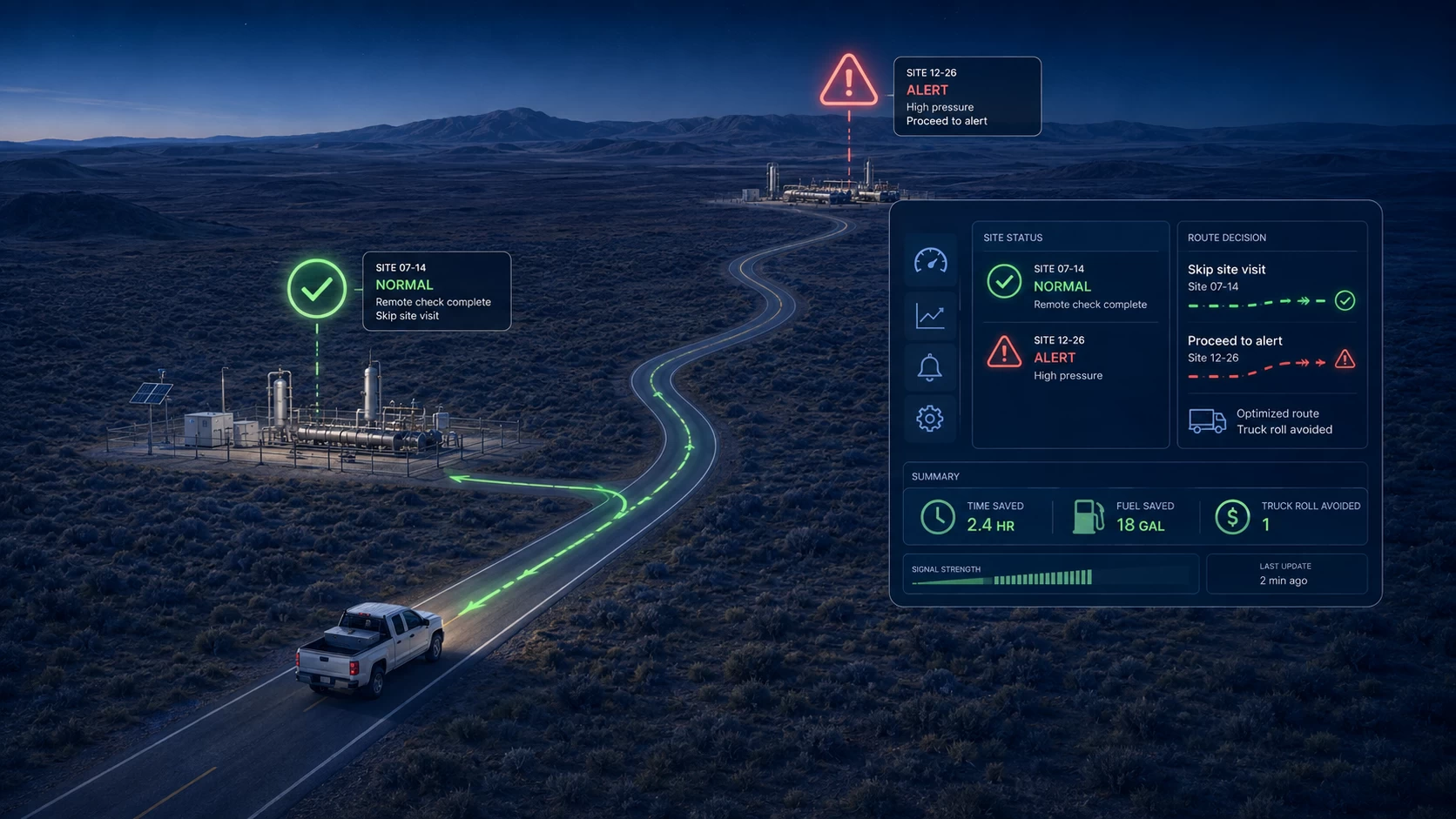
A truck roll is not automatically waste
A field visit has value when someone needs to repair equipment, perform maintenance, inspect a physical condition, verify a safety issue or complete work that requires a person on site. The problem is the trip whose main purpose is to learn one fact that could have been known before the truck left.
That distinction matters. Remote monitoring should not be sold as a replacement for field personnel. It is a way to give those people better information before dispatch, help prioritize the sites that actually need attention and reduce routine information-gathering trips where the data says the site is operating normally.
What does 'truck roll' mean in field operations?
A truck roll is simply a dispatch to a field location. In oil and gas, natural gas measurement and other distributed operations, that can mean sending an operator, measurement technician, electrician, instrumentation technician or contractor to a site that may be many miles from the nearest office or from the technician's current route.
The term sounds like a transportation cost, but the truck is only one part of the economics. The more important question is what productive work the person could have been doing instead of spending that time driving.
What a truck roll actually consumes
- Labor and windshield time, including the loaded cost of the person making the trip.
- Fuel, tires, maintenance, depreciation and general vehicle wear.
- Opportunity cost when a skilled field person is driving instead of troubleshooting, maintaining or commissioning equipment.
- Safety exposure created by additional road miles, weather, nighttime travel and difficult site access.
- Response capacity. A technician already committed to a routine check is less available for a site that develops a real problem.
- Follow-up cost when the first trip does not provide enough information, the right parts are not on the truck or a second specialist has to be dispatched.
A better operating target is fewer blind truck rolls. If a person has to go to the site, remote data should help answer why they are going, how urgent the trip is and what condition they should expect when they arrive.
Remote monitoring changes the first question
Without remote visibility, the first question after a phone call, missed reading or suspected problem is often: Who can drive there and look at it?
With useful telemetry, the first question can become: What changed? Pressure, temperature, pulse or flow activity, battery condition, signal quality and post history can provide enough context to decide whether the site is normal, developing a problem or already outside an operating threshold.
That does not remove the field response when work is required. It changes the dispatch from an information-gathering trip into an informed response.
A simple example shows why distance matters
Consider one remote site that is checked twice each week. If the round trip consumes two hours, that is 208 labor hours per year before counting any work performed at the site. If the route is 90 miles round trip, the same schedule adds 9,360 vehicle miles per year.
Those numbers do not prove that every visit can be removed. They do show why it is worth separating necessary field work from trips made primarily to collect a reading or confirm that everything is normal. The farther the site is from the normal route, the more valuable that distinction becomes.
Calculate the cost using your own route
Use your actual visit frequency, round-trip time, loaded labor rate, mileage and vehicle cost instead of relying on an industry average.
Use the Site Visit Cost CalculatorWhich truck rolls are the best candidates for remote monitoring?
The strongest candidates tend to be repetitive visits where the operator is collecting a small number of measurements or confirming that the site is still within normal conditions. A site does not have to be completely unattended to benefit. Even a location that still receives scheduled inspections can become easier to manage when operations can see what is happening between those visits.
Look first at sites with these characteristics
- Frequent routine checks for pressure, temperature, meter activity, flow or equipment status.
- Long drive time or a site that sits outside the normal field route.
- A clear operating range or alert threshold that can help determine when attention is needed.
- A history of arriving at the site and finding that everything is normal.
- Problems that develop over time, where trend data can provide useful warning before a failure or shutdown.
- Sites where knowing the current condition before dispatch helps the technician bring the right tools, parts or personnel.
Remote monitoring can complement SCADA, not compete with it
A truck-roll reduction strategy should fit the customer's existing automation environment. R3CON can use the DFELAB cloud for dashboards, reporting and alerts, or selected telemetry can be integrated into an existing SCADA, historian or reporting workflow through API, FTP and custom views.
If a PLC or RTU already owns process control, safety logic or interlocks, that control architecture can remain exactly where it belongs. The value of R3CON can simply be adding field visibility where it is useful and delivering that information to the system the operator already uses.
Which site are you driving to just to get one number? That question often identifies a better first monitoring project than starting with a long list of sensor specifications.
Monitoring is most valuable when it changes a decision
Collecting more data is not the objective. The telemetry has to change what operations does next. A normal reading may justify leaving a site on its scheduled route. A low-pressure condition may justify moving it to the top of the day's work. A developing freeze condition may justify action before production is affected. A meter pulse history may answer a usage question without asking someone to make a special trip.
That is the practical connection between remote monitoring and truck-roll economics: visibility helps distinguish the sites that need people from the sites that only need to be seen.
Industry experience points to the same operating principle
DPS Telecom describes truck-roll cost in terms that include labor, safety exposure, opportunity cost, fuel and vehicle wear, and emphasizes using remote monitoring to eliminate or better plan trips that do not require immediate physical work. A Halliburton case study from Permian Basin ESP operations similarly reports that remote optimization allowed technicians to be sent when more complex field work was actually required.
Further reading: DPS Telecom on wasted truck rolls and Halliburton's remote optimization case study.
Truck roll questions we hear from operators
Bring us one site that gets too many information-gathering visits.
Define what your team drives there to check, how often they go and what remote data would need to show for the trial to be useful.
Request a Field Trial