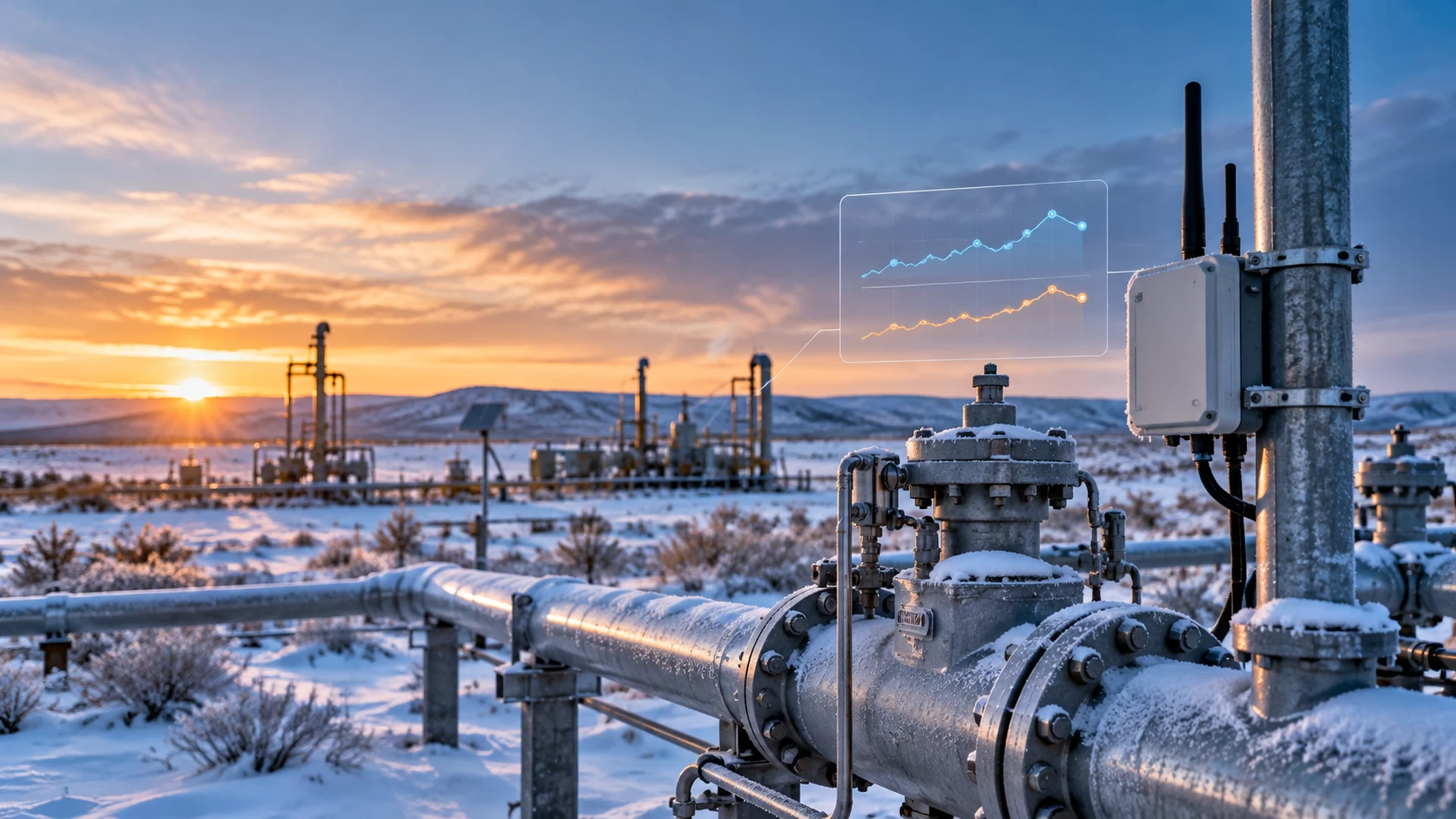
The first freeze is often a visibility problem
A remote gas site can change between scheduled visits. A regulator may become obstructed by ice, moisture may affect an instrument line, or a weather event may make the access road impassable. The field team still has responsibility for physical inspection and safe operation, but it may not know which site needs attention first.
When colder weather sets in, the practical question is not simply whether a location has a temperature sensor. It is whether operators have enough trustworthy pressure, activity, and communications history to recognize a change before the next routine truck roll.
Why winter risk is back on the agenda in 2026
In a February 2026 pipeline safety advisory, the U.S. Pipeline and Hazardous Materials Safety Administration (PHMSA) highlighted hazards involving heavy snow and ice, ice expansion, frost heave and ground movement, and flooding during rapid thaws. PHMSA emphasized winterization of above-ground facilities and monitoring of conditions that may affect pipeline integrity.
At a gas measurement or regulation site, these risks can involve piping, regulators, vents, instrumentation, control lines, and access to equipment. A simple sensor cannot identify all those conditions. But a well-planned telemetry layer can make some changes in operating behavior easier to see and investigate.
PHMSA explicitly states that the February 2026 advisory does not create new regulatory obligations. Existing inspection and surveillance requirements depend on the facility, operator, jurisdiction, and applicable rules. Adding remote telemetry does not by itself establish regulatory compliance or replace required patrols and inspections.
Pressure trends: useful evidence, not an automatic diagnosis
An approved pressure sensor can show whether a location is operating within its usual range and whether pressure is rising, falling, or cycling differently than before. A persistent deviation may help prioritize an inspection. It cannot, by itself, tell an operator whether the cause is regulator icing, upstream supply variation, changing demand, sensor drift, or an actual release.
The sensing point, expected range, accuracy, calibration, environmental rating, and permitted connection all matter. Any operational decision should use the site’s established procedures and additional evidence.
Pulse activity: a window into changing site behavior
Where a meter or flow computer provides an authorized pulse output, counting those pulses over time can reveal changes in activity. An unusual increase, an unexpected drop, or a flat trace at a normally active site can be a useful reason to investigate. None of those patterns proves a leak, freeze-up, or equipment failure.
Pulse interpretation also depends on the pulse factor, signal compatibility, device configuration, and whether the upstream instrument reports corrected or uncorrected quantities. Trend monitoring should not be presented as independent custody-transfer or billing measurement.
Temperature and connectivity: context that changes the priority
Ambient or enclosure temperature helps put pressure and pulse trends into context, especially when a site has just experienced a cold snap. But enclosure temperature is not the same as gas, pipe-wall, or regulator temperature; measuring those conditions requires the appropriate dedicated sensor and installation.
Communications status is equally important. A site that stops reporting during a storm has a data gap, not proof that flow stopped. Low available power, antenna damage, network coverage, or equipment faults may explain the silence. A useful dashboard distinguishes the last known reading from a current measurement and prominently shows the age of the data.
Build the winter monitoring plan around the operating decision
1. Define a normal baseline. Capture representative pressure and authorized pulse trends before winter, accounting for shift patterns, seasonal demand, and expected operating cycles.
2. Decide which deviations matter. Set review thresholds and escalation procedures with the operations team. A minor departure may justify a scheduled check; a hazardous condition must follow the approved safety response, regardless of whether telemetry is available.
3. Match reporting intervals to the risk. Periodic battery-powered uploads may be hours apart, while externally powered installations may report more frequently. Neither should be described as continuous, instantaneous protection unless the complete system is designed and validated for that duty.
4. Test winter failure modes. Check sensor fittings, moisture protection, enclosure seals, cellular coverage, power reserves, cold-temperature operating limits, and any solar charging restrictions before the next hard freeze.
5. Make offline sites visible. Define what counts as stale telemetry, who reviews it, and how crews confirm status when a device misses its expected report.
From a dashboard reading to a better truck roll
Consider three remote sites following a cold night. Site A shows a modest pressure change consistent with its established operating range. Site B shows several consecutive pressure readings outside its normal pattern while authorized pulse activity also changes. Site C has not checked in since the storm.
Those observations do not diagnose the cause or guarantee which location is safe. They do give dispatchers a more informed starting point for verification, communications troubleshooting, and field inspection. This is the practical value of remote telemetry: converting scattered readings into a clearer operational history.
Where R3CON fits
DFELAB’s R3CON platform is designed to extend visibility at remote locations through supported field inputs, including authorized pulse signals and appropriately selected pressure or temperature sensors, with cellular reporting where network coverage is available. The portal gives teams historical readings and device reporting status that can support exception review and site prioritization.
R3CON is not a certified leak-detection system, an emergency shutdown device, or a replacement for a custody-transfer meter, flow computer, SCADA safety function, or required inspection. A deployment should be engineered around the existing equipment, measurement purpose, power source, reporting interval, environmental limits, and site procedures.
A practical question before the next cold snap
Which of your remote gas, regulator, or measurement locations would be hardest to assess after two days of snow or freezing temperatures? Start with those sites. Identify the data that would actually change a field decision, confirm how it can be collected safely, and put a communications and inspection plan around it.
Remote monitoring does not eliminate winter risk. It can reduce the time a meaningful change stays invisible between visits.
Sources and further reading
PHMSA, February 6, 2026: Extreme Winter Weather Safety Advisory.
PHMSA: Dangers of Abnormal Snow and Ice Build-Up on Gas Distribution Systems.
49 CFR 192.613: Continuing Surveillance (for covered pipeline operators).
Get a clearer picture of your remote sites this winter
Discuss a field trial that starts with the signals you already have, the information your team needs, and the realities of power and cellular coverage at the site.
Request a Field Trial