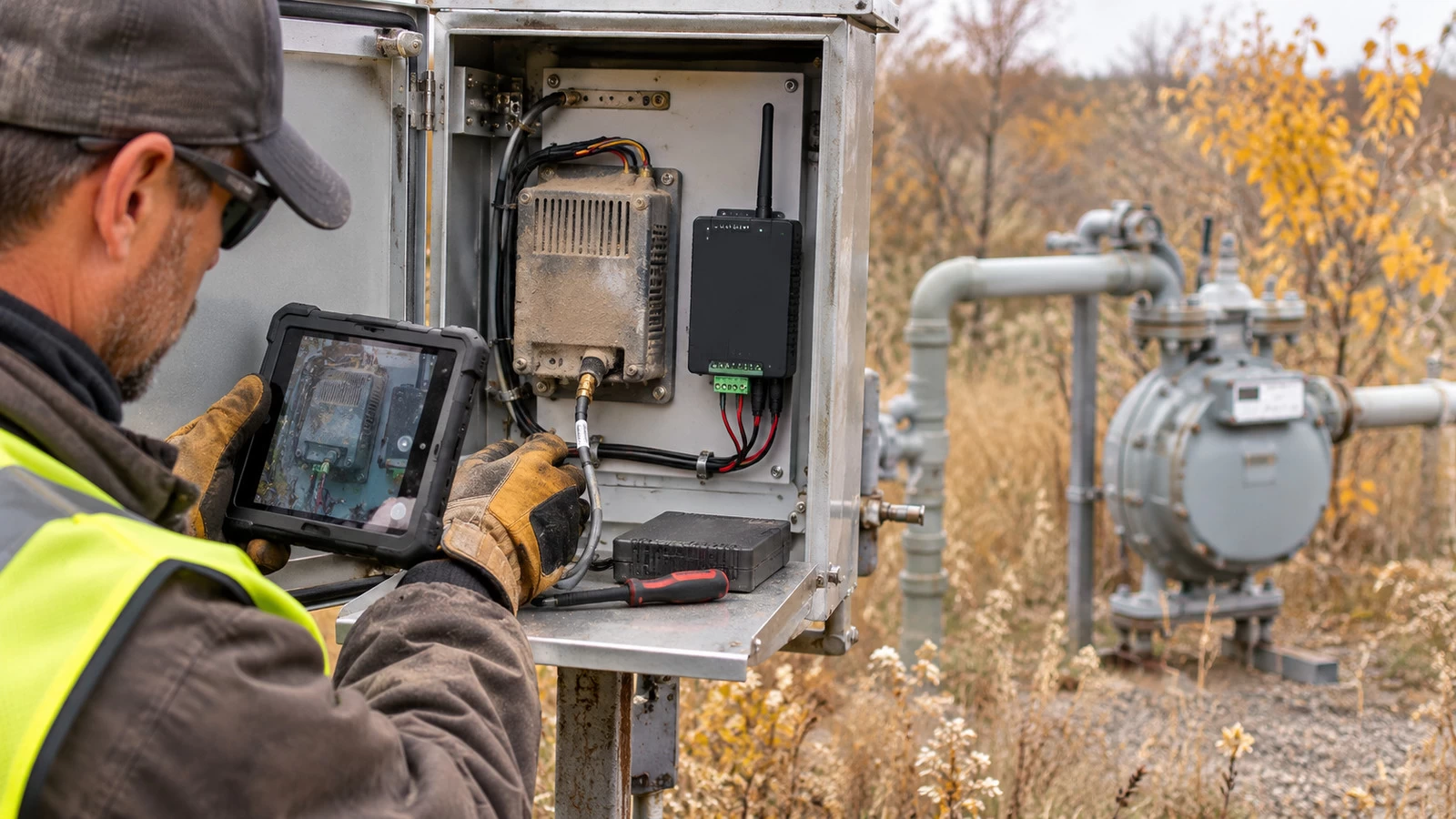
When the reporting stops, the meter may be fine
The first sign of trouble is often a blank dashboard. A remote gas location that once checked in every day goes quiet. A crew arrives expecting a meter problem, only to find that the instrument is still operating while the battery, modem, antenna or communications service has failed.
For fleets installed in phases over many years, the result is a collection of blind spots. Some locations report regularly. Others provide only their last known value. A few may still have usable instrumentation but no supported way to move its information to the people who need it.
That distinction matters: replacing a failed communications layer is not necessarily the same job as replacing the measurement equipment.
Why 2026 is a useful deadline for reviewing older field units
The cellular transition is no longer hypothetical. Equipment maker Particle documents that T-Mobile completed the shutdown of its 2G network on August 3, 2026, leaving affected 2G/3G product models unable to connect in the United States. AT&T and other large carriers retired their 3G services earlier. A device designed around one of those older radio technologies cannot be revived simply by inserting a different SIM if its hardware lacks a compatible network interface.
The lesson extends beyond 2G. Solar panels, primary batteries, connectors, seals, antenna cables and firmware age on their own schedules. A fleet can lose availability gradually, even when no single network event causes the failures.
In a separate June 25, 2026 initiative, NIST's National Cybersecurity Center of Excellence identified geographically distributed assets, older technology and incomplete inventory records as common challenges for operational technology teams. For remote operators, that makes a current site-and-device inventory the logical first step toward modernization.
A dead cellular radio can make a functioning site appear offline. Before replacing the instrument, determine whether the missing data originated at the meter, the signal interface, the telemetry electronics, the power source, the carrier or the server. The last value displayed in a portal is not evidence of current flow or pressure.
What can be kept, and what should be replaced?
A retrofit should begin with a physical and electrical review rather than an assumption that all existing hardware must be discarded.
An installed meter or flow computer may continue doing its intended job. An authorized pulse output may be suitable for a new monitoring input, and a properly rated pressure or temperature instrument may also remain serviceable. Existing mounting hardware, wiring routes and enclosures may be reusable when their condition and applicable installation requirements are verified.
Other components may warrant replacement: a radio tied to a retired network, a failed battery, a damaged solar panel, a degraded antenna feed, compromised seals or an undocumented control board.
Reuse is never automatic. The new interface must match the source signal's voltage, pulse width, polarity, frequency, isolation and electrical limits. Hazardous-location approvals, environmental protection, grounding and installation practices must be assessed for the entire modified assembly by qualified personnel. A mechanically convenient swap is not sufficient evidence of suitability.
Preserve the site history, not just the device identity
When a legacy monitoring unit is retired, the old device identifier often disappears with it. But the physical site remains, and the value of its historical trend should not disappear because an electronics board changed.
Keep a stable site or location identifier distinct from the serial number or modem identifier. Document the original unit, the replacement unit, the date and time of the change, and the last reliable observation from each system. Retain source metadata such as units, sensor location, pulse configuration, time zone and any known corrections or transformations applied to displayed trends.
The handoff also needs to show uncertainty. If the previous unit stopped reporting on Monday and the replacement was activated on Thursday, do not connect the two points as though uninterrupted readings existed in between. Label the gap. If a cumulative counter resets during the swap, record the last known old count and the new starting count separately. Never invent missing measurements or claim those trend values constitute custody-transfer totals.
How to tell an offline monitor from an inactive process
A modern monitoring portal is most useful when it separates device health from process behavior.
A device that checks in on time but reports no additional authorized pulses is different from a device that missed its scheduled connection entirely. A pressure value that remains exactly constant may reflect stable operation, sensor problems, limited resolution or stale data. An implausible temperature can point to a disconnected sensor rather than an actual site condition.
For each observation, operators should be able to answer three questions: When was it measured? When did the device report? Has the value been verified as plausible for this installation?
Those checks help operations teams decide whether to examine the instrument, troubleshoot communications, verify site power or schedule a physical inspection. A flat trend alone does not prove zero flow, a leak or a safe operating condition.
A five-stage retrofit plan for an aging fleet
**1. Inventory and classify.** Record each location, legacy hardware, carrier and radio technology, instrument signal, power source, last confirmed contact, hazardous-area constraints and the consequence of losing monitoring. Separate offline sites from those still reporting reliably.
**2. Validate one representative configuration.** On the bench and, where appropriate, in the field, confirm pulse characteristics or sensor scaling, required isolation, network registration, data age, power consumption and restart behavior. Do not assume two installations are identical just because they use the same meter model.
**3. Pilot before scaling.** Test several sites with different coverage, power and instrument arrangements. Establish what counts as a successful report, a meaningful anomaly and an offline alert. Compare trusted local instrument observations with the new remote trend display.
**4. Swap with a traceable handoff.** Photograph and record approved connections, preserve historical records, mark the precise cutover time, configure the replacement against the persistent location record, and retain a safe rollback plan when practical.
**5. Verify after the crew leaves.** Check multiple scheduled reports, confirm device health, review trend plausibility and make sure alerts reach the designated operator. A successful first upload is only the start of acceptance testing.
The economics are about field work, not just equipment cost
The price of a new telemetry board is only one part of an upgrade. Operators also pay for travel, access arrangements, hazardous-location procedures, troubleshooting, technician time, recurring service and future battery maintenance.
Replacing compatible telemetry while retaining suitable instruments can reduce unnecessary rework, but only after the actual site conditions are confirmed. Conversely, reusing a cracked enclosure or an unsuitable sensor to avoid a small upfront expense can produce a more costly return visit.
A useful migration budget compares complete installed-and-maintained approaches over a realistic service interval. It should identify which locations need a full rebuild, which can accept a qualified modular retrofit and which should wait until their existing instrumentation is also due for replacement.
Where R3CON fits
DFELAB's R3CON provides a remote monitoring layer for supported field signals, including authorized pulse outputs and suitably selected pressure and temperature inputs. With an appropriate configuration and available cellular service, the platform can present historical trends, reporting status and site-level exceptions to help operators prioritize follow-up.
For operators with older monitoring equipment, a scoped R3CON field trial can establish whether existing instrumentation can be retained, what electrical and environmental changes are needed, and how the new data should be associated with the historical location record.
R3CON is not a certified custody-transfer meter, a guaranteed leak-detection system, an emergency shutdown device or a substitute for required inspection. A retrofit must be evaluated for each equipment version and site; no service-life, zero-failure or exact alert-latency promise should be inferred from this article.
Cellular-network retirement is an operational compatibility issue, not a new federal rule requiring every gas site to install telemetry. NIST's June 2026 OT asset-management project describes recommended approaches and a draft project scope, not a new pipeline monitoring mandate. Applicable design, inspection, hazardous-location and safety obligations must be determined from the specific facility, jurisdiction and equipment. Remote trend monitoring does not replace mandated measurements or safety functions.
The best retrofit restores a trustworthy view of the site
A modernization program should not be judged by how many new boxes were installed. It should be judged by whether an operator can see which locations are reporting, recognize when data is stale, understand the measurement context and send crews where verification is needed.
If the meter still works, there may be no reason to replace it merely because the modem stopped calling home. Start with the field evidence, preserve the history and modernize only what the application actually requires.
Sources and additional reading
Particle, U.S. 2G/3G sunset and device impact; NIST NCCoE, June 25, 2026 OT asset-management project; NIST, June 25, 2026 draft project description.
Have a working meter and an aging monitor?
Start with a site-specific review of the existing signal, enclosure, power, connectivity and desired monitoring history. A focused R3CON field trial can help determine what should be retained and what needs to change.
Request a Field Trial